Showing posts with label Identification Skills. Show all posts

Sunday, 1 December 2013

Identifying a Mystery Nighttime Visitor

Riddells Creek Landcare recently purchased several Scout Guard trail cameras for use by members interested in photographing and identifying nighttime visitors and other camera-shy creatures. There have been a few mystery creatures on my property that that I have not been able to confidently identify. This is the account of one of these mysteries that I finally solved with the help of the trail camera. I'll give a more complete report on usage of the camera in a later post after I've resolved a few more things and when I'm ready to return the cameras for others to use.

One of the Scout Guard Trail Cameras. The front face of the camera has the following features from the top down: Infra-red LED flash unit for low light and night photography. The camera lens (note that it is protected from rain and direct sun by an "eyebrow". An infra-red motion detector that is used to trigger the camera. The easiest way to deploy it is simply to strap it to a tree or post using the supplied strap.

The camera contains an internal clock and control computer and has several user settings: date and time (to be recorded on the images), video/camera, number of pictures to be taken in a sequence when triggered (3 is the default, with an interval of ~1 sec. between each), delay following a trigger (one minute is the default), and trigger sensitivity.

My mystery began when my wife and I heard a strange animal noise as we were going to bed between as hiss and a faint scream followed by something zipping past the bedroom window that I couldn't properly make out. Whatever it was, it wasn't a rabbit or a cat - of which we have far too many. When the house was built, we laid pebble mulch along the side of the house - which happens to provide a nice path for animals to follow. So, one of the first uses of the camera was to set it up looking down the path to try to identify what the animal might be.

You can just make out an ear and forehead to the right of the second post behind the overexposed grass in the foreground facing towards the camera.

Note the sharpish nose and long running legs. Might it be a fox?
Look at the skinny tail, either hairless or covered by very short hair. Couldn't be a fox.
Given the frequency with which we see foxes passing through the property during daylight and the number of chickens and even a full grown goose taken in the night, we know there is no scarcity of foxes in the neighbourhood, but the foxes we have seen all have luxuriantly bushy tails. This looks like no fox I have ever seen. Except for its long legs, it is also not much larger than a prowling cat which conveniently posed in the same spot (the stake the camera was on was moved slightly further back before the cat sequence was taken).


Not a cat I have seen before during daylight.
Note the position of the cat relative to the vine twisting around the post. Although it stands higher off the ground, the body size of the unknown creature is only slight larger than the cat's.
I have had one or two cameras out now for three weeks looking for unknowns. I lost a week on each of the two cameras. One because I partially ejected the memory card in the process of turning the camera on (one week of camera time wasted!), and the other when I forgot to turn the camera on before I tied it to a stake (another week of camera time wasted!).

However, I have several more pictures of the mystery animal, both by the bedroom and on the bridge out to the small island in our dam. Coming towards the camera.


Going away from the camera 10 minutes later:

Far end of bridge walking away from camera. This guy might have a fox tail.


Definitely a small fox in the above sequence

More cats to establish size:

Another one I have never seen during daylight.
Yet another cat not seen during the day


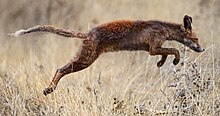
To resolve my questions, I scrolled through numerous fox pictures on Google Images ([IR "red fox"], ["trail camera" "red fox") and got lots of hits, including many with comparable lighting to mine. The notable thing about all of these is the luxuriantly bushy tail - which definitely does not fit my unknown culprit. Wikipedia "red fox" finally solved the conundrum, with a daylight picture. Following are a couple of shots from that page of what foxes should look like:


The last shot removed any doubt that all of the fox-like creatures photographed by the trail cameras were in fact foxes:


This guy is suffering from mange! According to Wikipedia "The mite Sarcoptes scabiei is the most important cause of mange in red foxes. It causes extensive hair loss, starting from the base of the tail and hindfeet, then the rump before moving on to the rest of the body. In the final stages of the condition, foxes can lose most of their fur, 50% of their body weight and may gnaw at infected extremities. In the epizootic phase of the disease, it usually takes foxes four months to die after infection."

My wife hates foxes (we have given up trying to keep chickens on the property), so says Hooray! that at least one fox is suffering.

More to the point is that the trail cameras have shown beyond a doubt that our 5 acre property is overrun with nocturnal predators that don't belong in Australia - at least three different cats and two different foxes, not counting the occasional sightings during daylight hours. Hopefully they are at least keeping the growing rabbit population under some kind of control.

Thursday, 30 May 2013

Using the trail camera to see the results of digging a hole, planting some natives, and adding water


Trying out the "Infrared Digital Scouting Camera - Pocket Camera SG570-6M"

Riddells Creek Landcare Committee has purchased 5 trail cameras that will eventually be made available for members to borrow. I've been experimenting with one of these on my property, and in two days picked up two new bird records for Riddells Creek. Actually, both species are frequent visitors to the property, but haven't made themselves available or haven't cooperated when I had a camera in hand.

The first shots were of a little pied cormorant, Microcarbo melanoleucos (http://natureshare.org.au/observation/9160/). There were two pictures of the bird, both facing away from the camera, so my initial ID was wrong. My Claremont Field Guide to the Birds of Australia unfortunately lacks a good picture for the little pied, and I mistook what Russell Best pointed out to me was actually the tip of the beak, for a yellow patch over the eye (see the enlargement of the picture below) that is diagnostic for the pied cormorant, Phalacrocorax varius. What I failed to pay attention to was the absence of a black strip on the leg feathers of my bird, but is typical of the other black and white cormorants (see James Booth's picture of a pied cormorant standing on a wire [!] - http://natureshare.org.au/observation/8360/). The absence of the stripe is diagnostic for the little pied.


The next set of pictures are of a white-faced heron (Egretta novaehollandiae - http://natureshare.org.au/observation/9151/). These are also regular visitors to my dam, which isn't surprising because the neighbour (who called them "blue herons" said that last year they nested in a tall eucalypt next door.


Several species of waterbirds regularly use the bridge rail as a perch on arriving or departing from the dam, so my first choice of a spot for the camera was where it could see the rail. This is an easy place to land where they can check out the area for potential dangers before beginning their fishing.

Building a paradise for birds and aquatic life


The pond is a great success for the property. When we bought our Two Hills Estate property in 1991, it was a 5 acre bare paddock without a stick on it, and only a slight depression conducting runoff to the muddy pond next door. (The fence separates us from the neighbour's 15 acres.). We picked the property specifically because it did have a little drainage passing through it.

Newnham was still building the estate's roads and had his earth movers parked around, so we asked him for a price to prepare the house site and build a drive. I also asked asked if he could dig out a small pond. He suggested that I think a bit larger and sketched out how he could use the existing drainage and run a large dam along parallel to the property line to make a good sized pond. What we ended up with was an impoundment 140 m long by 40 wide, with a 10 m x 14 island, for an all up cost for the earthworks of around $5,000 (see below for the just about finished stage). The result of the plantings is that we lost our view of Barrm Birrm, but turned the bare paddock into a paradise for birds and other small wildlife that have been able to cross the horse paddocks to reach it.


Ros and I, with a couple of friends began to add vegetation, as can barely be seen in the next photo from a year later, thanks to a flying doctor who takes aerial photos to pay his costs for his hobby. The lower dam is the neighbour's that dates back to the days when Two Hills was a horse stud. The middle tree is the one where the herons are said to roost. The bridge to the island was hand-built with only a handsaw and an augur and no measurements as the lake was rising around my feet from a wet winter. Because the property gets the runoff from Cutevan Cr, even in the drought years there has been enough rain to fill the lake to full supply (i.e., the level of the trickle tube), even if there was not enough for a flow over the spillway.

 The "after" pictures are below - showing what can be done with tube-stock trees and a little water!

 As shown in the next picture, the bridge was "designed" as a drawbridge to protect nesting birds. A pulley can be attached to the posts to lower the 2" x 8" x 8' sleepers serving as the bridge itself. The middle railings slot into place once the sleepers have been lowered. The trail camera was strapped to the nearer post and aimed at the railing to see who lands on it. 
 

The final picture (below) is from last year, showing the extent of vegetation on the property around the lake - showing what can be done in 21 years with a bulldozer, some tube stock, labour, and a little water.


Sunday, 5 May 2013

Antarctica in Riddells Creek

Dicksonia antarctica that is, Soft Tree Ferns. 

Conversations with RCL member Robert Blair revealed that he had tree ferns on his property, high up on Gap Road. So I had to investigate further! Robert kindly took me on a walk up to the headwaters of a small Sandy Creek tributary that, these days, appears to rarely see flowing water. And sure enough, there it was, but only one remaining alive (plus one that had recently passed away but only time will tell if it springs back to life).


It seemed obvious that this one had only survived because its trunk (left) was growing in a deep hole that was likely to trap water.

Excitingly though, we also found one other living tree fern further down the same creek line and this turned out to be a different species, the Hard (or Rough) Tree Fern, Cyathea australis. This was easily identifiable from a few spores that remained on the underside of the fronds.


Dicksonia antarctica, Soft Tree Fern, is perhaps the most iconic of the Australian Tree Ferns can grow to15m tall, grows no more than 5 cm per year and produces spores after about it reaches about 20 years old.

And of course they reached Riddells Creek many millennia ago, ferns being among the most ancient group of plants.

The two species often grow together and are similar in their habit. There are two good ways to tell them apart. First, the spores are very different in appearance if you are lucky enough to see them. Earlier this year I saw both in spore at the same time at Lake Elizabeth in The Otways. The photo below is Dicksonia antarctica, Soft Tree Fern, with its pustule like spores.
... and below is Cyathea australis, Hard Tree Fern, from Lake Elizabeth.

If they aren't in spore (as is often the case) then the trunk and base of the fronds is the key. In young plants you will often have fight through the old fronds to reach the trunk but in old, tall plants the trunk is easily seen. As the trunk grows the base of the fronds remain and cover the trunk. In the Hard/Rough Tree Fern the old frond bases are very hard and 'prickly' (press them and they don't compress at all) and they are surrounded by hard, greyish string/hair-like structures. In the Soft Tree Fern the frond bases are soft (press them and they will collapse/break) surrounded by soft, reddish-brown hairs. Here is trunk of the Soft Tree Fern:

... and here is the trunk of the Hard/Rough Tree Fern:

They are magnificent in rainforests, reaching great heights and they can occasionally be seen like this in the Macedon Range, but many populations struggle to reach great heights. As at Robert's place, these plants will struggle as areas dry out.

Finally, Robert is of Scottish heritage and so may be interested in the derivation of the botanical name:
Dicksonia - named in honour of James Dickson, 1738-1822, a Scottish nurseryman.
antarctica - 'southern', or from the Antarctic regions.
Cyathea - derived from the Greek kyatheion, meaning "little cup", and refers to the cup-shaped spores on the underside of the fronds.

Here is a lovely Hard/Rough Tree Fern from Lake Elizabeth:


Sunday, 21 April 2013

You Wouldn't Want to be a Spider - Spider Hunting Wasps

Spiders and snakes are probably the most maligned groups of species. Spiders are renowned for catching eating unsuspecting prey but spiders too are under attack.

There is a group of wasps specifically known as Spider Hunting Wasps. They comprise the family Pompilidae and this week I've spotted or named two species from Riddells Creek and another from Daly Reserve in Gisborne. They are quite noticeable by their behaviour - they fly just above the ground scanning an area for spiders, landing occasionally but forever on the move.

A few weeks ago I spotted a Zebra Spider Hunter Wasp at Daly Reserve and this species I finally spotted in Riddells Creek last week (a new species record for Riddells Creek). I managed to key it out via a 1984 paper from the Australian Journal of Zoology as Turneromyia bassiana and this ID was later confirmed by Ken Walker (Head of Entomology at the Museum), http://natureshare.org.au/observation/8946/

As mentioned, this species was also spotted at Daly Reserve, Gisborne, where more details of its behaviour was observed. The pic below was taken while it 'tapped' on the stick across the small hole in the ground. It is assumed this is its den since we later saw another individual digging a similar hole. The dirt from the diggings is seen right of the picture below, http://natureshare.org.au/observation/8828/

The above species inspired my daughter, Lydia (10), to draw the lesser known 'Zebra Spider Hunter Elephant' ...

I've only seen the Zebra Spider Hunter Wasp in forested areas (with grass-dominated understorey) but the next species I've only seen (but regularly see) on Riddells Creek's grasslands. It is easily seen because it is very brightly coloured. It is Cryptocheilus bicolor (Orange Spider Wasp). It is also very difficult to photograph because it is very flighty and keeps a good distance (from me anyway). The individual pictured below is pulling a spider into a large crack in the drying basalt clay, http://natureshare.org.au/observation/5875/

The spider wasp below is commonly seen but more commonly heard at my house. It is a hyperactive wasp and forever building mud nests all around the house, especially buzzing away in the grooves of our fly-wire security doors. I accidentally knocked off a nest once and found it contained more than a dozen small spiders. I have only worked it out to genus level, Fabriogenia spp., http://natureshare.org.au/observation/5770/ 
 
... and this dead one spotted by my daughter Ellena, http://natureshare.org.au/observation/8413/

At Daly Reserve, in the same area covered by the Zebra, I also spotted a much smaller spider wasp which turned out to be Psoropempula erythrostethus (ID by Ken Walker), http://natureshare.org.au/observation/8832/. I haven't spotted this species in Riddells Creek (yet):

But it doesn't stop there for the poor old spiders ... on the same day I spotted the Zebra in Riddells Creek, I also spotted this species exhibiting the same hovering/scouting close to the ground behaviour that is a feature of spider hunter wasps:
I initially thought this was also a Spider Wasp but close inspection of the photo shows the large spike emanating from the rear. This looks like a horrific stinger but is actually an ovipositor (used for egg-laying). This is a feature of Ichneumon Wasps (family Ichneumonidae). It was named to species level by Ken Walker as Tryonocryptus gigas, http://natureshare.org.au/observation/8949/. I suspect this species might be a spider hunter too. Ichneumon Wasps lay eggs in the host using the ovipositor. I also spotted this species at Daly Reserve within just a few metres of the two spider wasps.

So next time you see a spider, you may view it with a little more sympathy (or maybe not). Humans aren't the only ones giving them a hard time.

Friday, 22 March 2013

Dragonfly or Damselfly?

I was pointed to this lovely story the other day (thanks James):
http://focusonfauna.wordpress.com/2013/03/21/when-beliefs-are-shattered/ 
(please read the story before continuing here)

The story reads "My Rule 649 – Dragonflies and Damselflies says one of the differentiating features between dragonflies and damselflies is that dragonflies rest with their wings flat (open) and damselflies rest with their wings closed".

Here is an example of a damselfly that fits the rule (Common Bluetail): http://natureshare.org.au/observation/4669/ (NB. NatureShare is best viewed in Firefox, Chrome or Safari, not Microsoft Internet Explorer)


... and here is an example of a dragonfly that fits the rule (Southern Tigertail):http://natureshare.org.au/observation/1309/


The story then expresses great pain on discovering there are species that don't fit this rule. I share the pain! It is a well used 'rule' but the more I see, the more I realise there are quite a few species that don't fit the 'rule'. Here is an example of a damselfly that holds it wings open (Common Flatwing): http://natureshare.org.au/observation/7851/


But it is more painful – recently I came across a tiny dragonfly that holds it wings closed, the Common Shutwing (Cordulephya pygmaea) – it is apparently only seen in Autumn but fairly common (flying now in fact): http://natureshare.org.au/observation/8701/


Rather than a rule, wings being held open or closed is in fact a ‘rule of thumb’. A rule of thumb is nicely defined by Wikipedia as “A rule of thumb is a principle with broad application that is not intended to be strictly accurate or reliable for every situation. It is an easily learned and easily applied procedure for making some determination.” A bit like a ‘non-core’ rule. A good example of a rule of thumb we were all taught at school is ‘i before e except after c’ (as in receive). As it happens this rule has now been dropped by most educators because there are more breaches of the rule than there are examples of the rule working; ie. it is a very inefficient rule of thumb!

So there are breaches of the dragonfly-damselfly rule of thumb on both sides – most breaches occur for damselflies (there are quite a few that break the rule and hold their wings open), whereas I think there is only one family with one genus of dragonfly in Australia with wings held closed (Cordulephya – and only the abovementioned species occurs in Vic – I think). Despite this, the rule of thumb does work much more often than not so it isn’t too bad (as a rule of thumb).

As it happens there is another rule of thumb that works better for damselflies vs dragonflies. It’s the eyes. In one respect this isn’t as good as a ‘rule of thumb’ because it is harder to see with the naked eye (in comparison to wings held open of closed) but I can only ID these creatures from a photo and the eyes are easily seen from photos.

So how does the ‘eyes rule of thumb’ work? All damselflies have a large gap between the eyes (they are held a bit like a hammerhead shark):


Dragonflies have eyes that are touching (or nearly so):


But, of course, being a rule of thumb there are exceptions. The exceptions though are only the family Gomphidae, which are dragonflies with an obvious gap between the eyes. However, with Gomphidae species, the eyes generally aren’t separated as much as damselflies, they are medium-large dragonflies and they are quite distinctive in their own right (whenever I’ve seen a Gomphidae species it has been obvious they are dragonflies and not damselflies). Here is a member of the Gomphidae family (Yellow-striped Hunter - Austrogomphus guerini):
 

The good thing is at least one part of this ‘eyes rule of thumb’ is absolute – here is how to apply it:
1. Eyes touching or nearly so = always a dragonfly
2. Obvious gap between eyes = damselfly, or a dragonfly in the Gomphidae family

Finally, is there an actual ‘rule’ that works for dragonflies vs damselflies? The answer is yes. Taxonomically speaking all dragonflies and damselflies form the insect order called Odonata (Order: Odonata). Confusingly the common name for the order Odonata is ‘dragonflies’ (noting that it contains damselflies too). The order Odonata comprises two sub-orders: 1) damselflies (sub-order Zygoptera); 2) dragonflies (sub-order Anisoptera – sometimes called ‘dragonflies proper’). According to Theischinger and Hawking (Dragonflies of Australia) damselflies and dragonflies can be separated by wing venation, thus:

1. Damselflies – Discoidal cell is a simple quadrilateral (sometimes traversed by crossveins, occasionally open at base).


2. Dragonflies – Discoidal cell is divided into a hypertriangle and triangle (often differing in shape in fore- and hindwing, and often traversed by crossveins).


Here are all the damselfly and dragonfly species we’ve found (so far) in Riddells Creek
http://natureshare.org.au/collection/28/
Using this list, the wing venation isn’t always easily visible but you’ll be surprised how many times you can see it. (NB. once in a specific observation in NatureShare – click on the largest square beneath a photo to see the photo in its largest resolution).