Showing posts with label Talks. Show all posts

Tuesday, 2 October 2018

The Sunbury Rings


We’re standing beside one of the Sunbury Rings with Uncle Dave Wandin, part of the Narrap Team that manages  properties owned by the Wurundjeri Council. When I first heard about these ceremonial grounds on the outskirts of Sunbury, I imagined in my mind’s eye a broad raised mound on the creek flats, hidden away somewhere, an ancient gathering place for hundreds. The reality is different: the rings are small, inscribed into the hillside above Jacksons Creek, the weathered shape of bank cut into on one side of the slope and the earth moved to the other side to make up a circle of level ground four metres or so across.


In fact, nothing is as I imagined it. The Rings are not hidden away, but in plain view, on the side of the valley across from the railway line as it descends into Sunbury. I must have looked out towards the Rings many times on the train to Melbourne. And these are not broad mounds where hundreds gathered, warriors rattling their spears, but something more intimate, a place where the men and women convened separately to make preparations, each out of sight of the other, then met in the third ring for a marriage ceremony, this site more complex, a circle contained in a wider circle, but still nothing grand, a place to sit in groups in the firelight, with singing and dancing in the centre of the circle, a living room if you like.

The Rings are high on the hillside because the valley was once not so deeply incised when they were first made and used sometime in the last 30,000 years. The creek would have been nearby. They were a place for family groups to meet, families that followed the seasons and the food, at a time when perhaps 20,000 Wurundjeri were living in all that country where the water flows to the bay. Not so many people in such a large area; now we have five million and more as development pushes out along creeks and hillsides just like these in Sunbury.

The original shape has weathered down, but the intent remains

And Uncle Dave isn’t quite as I imagined him. He’s wearing an orange AustralBricks jumper. He doesn’t hammer us with a sermon, but talks matter-of-factly of the life of the Wurundjeri then, as he and other elders have pieced it together from the historical record and family stories and from a feeling for how to live in this kind of country. The past and the present are a continuity for him. He is Wurundjeri, and a contemporary man, acceding to the wishes of his elders not to redig the Rings to their original shape, as he would like, but to leave them weathered, protected by fences, to leave them in peace now that a little of what had been has been recovered and granted some respect. Many elders are tired after the long fight, they too want a bit of peace, he tells us.

Uncle Dave Wandin
We walk along the hillside between the Rings and Uncle Dave shows us where he demonstrated traditional burning last year to the Hume Shire and other fire people, burning separate patches of grasses, each lit with one match he says, reading the wind and temperature conditions and the lie of the land to know exactly where each burn would finish. ‘We teach our kids to swim so they are safe and happy around water – why not teach them to use fire, so they are just as comfortable and safe with fire?’

I hear a mind and imagination at work here, learning how to heal Country, building links with mainstream fire and environment people, fighting the constraints imposed by regulation and planning, even when people with money and influence have different plans. 

We’ve been slow in the Landcare movement to make allies here, out of our fear for our property and fear of the other-ness of Aboriginal people. Yet hidden in plain sight, they are people like you and me, getting on with learning how to care for Country, whatever the obstacles.

Ross Colliver, Riddells Creek Landcare

Thursday, 30 August 2018

What if we thought of Barrm Birrm as a Park?

In the depths of winter, I drove north to Darwin, and came home with my soul full of this big land and park management on my mind. 


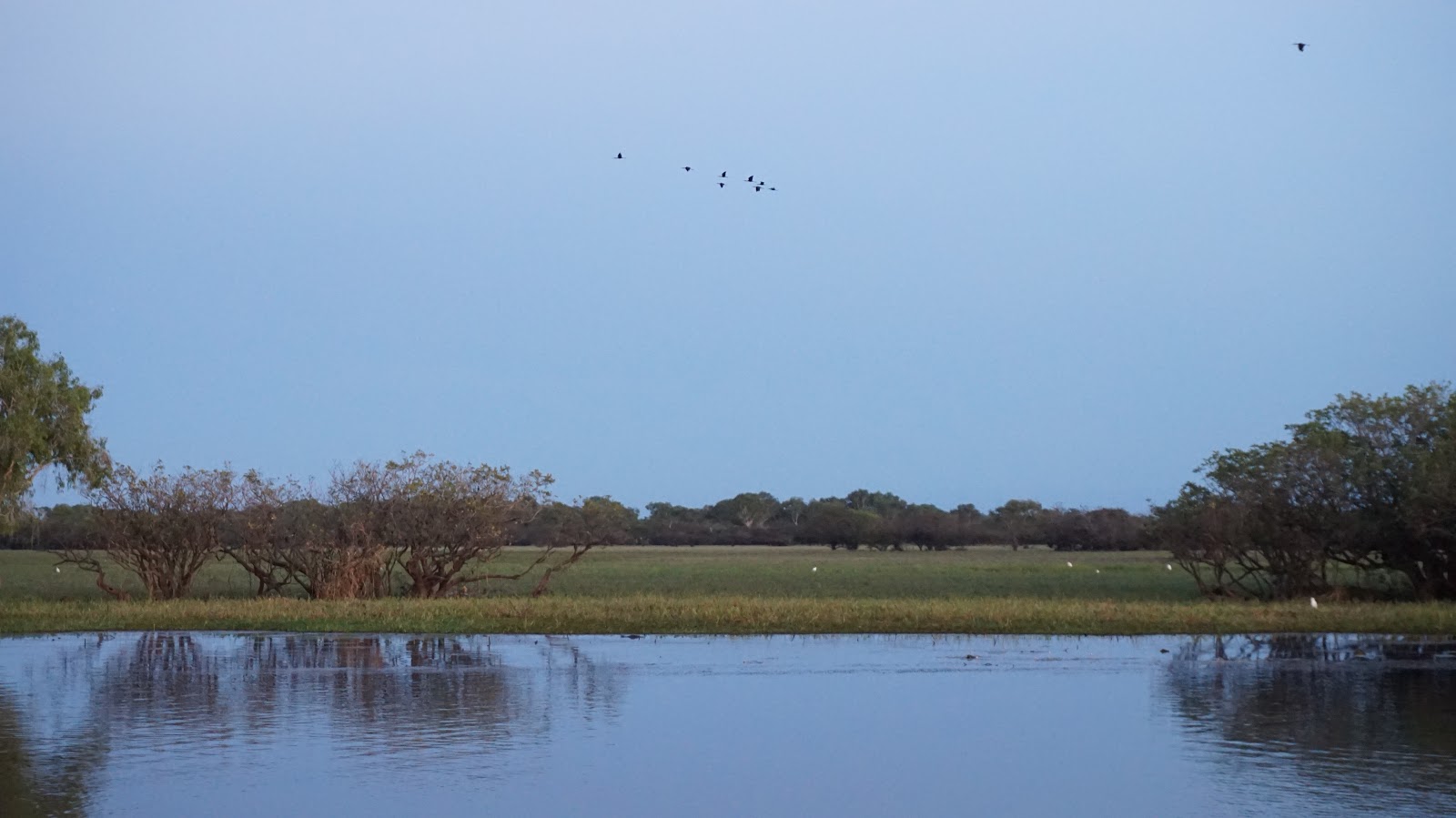
Yellow Waters, Kakadu National Park

Ulluru, on Anangu Country

It was still winter in Riddells, and the weeds and veggies had barely moved, but two new houses on Gap Road had their framing up, and another bush block ‘for Nature Lovers’ was up for sale.

You know what it's like when you come back from a good trip: half of me was still at Uluru and Kata Tjuta. The National Park is a case study in crowd control. The week before our stay, the camping ground stretched to 2000 people a night, in caravans, trailers and tents. Then there’s the four hotels and a couple of low-rise apartment complexes. All full: the winter months brought us greying nomads in droves, and it was the school holidays too.

Most of us were up before dawn, off to watch the dawn break over Uluru or Kata Tjuta, and quite few came back for the sunset, bulging 4wds and campers disgorging happy campers at strategically located car parks to sip vino and wait for that precise moment when the big rock turns bright crimson, a brief flare of luminous light before it sinks into the darkening horizon. 

Again, as it has for a long time.


We were all pretty well-behaved, but then, we were all very well managed. Excellent places from which to view the attractions, with good gravel paths and unobtrusive fencing to keep us in. Sealed roads, no access for off-road driving, good signage, toilets, water points on walks, thoughtful routes, and information at key points to tell us what we were looking at and how it was once used.

The Park is under joint management with the Anangu people, and a high point for me was a video at the Cultural Centre on the 1975 handback. People talked about what the handback meant to them. They were proud to have legal title to their Country, and happy that so many people now come and enjoy the Park, but behind the spectacle of this Park is the politics of white and black. Friends in Alice Springs told us the community is unhappy, ans that many feel that few benefits have flowed through to the community. Aboriginal heritage brings in the visitors, but just what ‘joint management’ means is an on-going struggle.

When I got home, I took a walk through Barrm Birrm, 120 hectares of bush uphill of Royal Parade and Gap Road in Riddells Creek. Eroding tracks run off into this place of many yams, a beautiful but troubled no-man’s land. Sub-divided into 165 lots in 1975, there’s never been permission to build. People hoped there might be, but the conservation value of the area now has priority.

Grsslands meet forest in the woodlands of Barrm Birrm

Who manages this de facto park? Precisely …. no-one. With no signs saying what you can and can’t do, and no fence to keep people out, Barrm Birrm showcases the best and worst of human nature. In the last two months: a truck-sized dump of soil and three trailer-sized dumps of garage rubbish; winter wood gathering and a frenzied axe attack on a cluster of trees; a deer shot, alive and left to bleed out, two foxes shot and laid out as trophies, a dumped sheep and a steel trap with a kangaroo leg in it. 


It's open season on deer at Barrm Birrm

Exotic acacias blooming. Tracks eroding. Bikes and 4WDs bashing more tracks to get around fallen trees. Spring will bring city campers who don’t know this is private land or the damage they do. When I despair, I think of the long game:

“Once a multiplicity of nourishing terrains, there is now a multiplicity of devastations. And yet, the relationship between Indigenous people and country persists. It is not a contract but a covenant, and no matter what the damage, people care.” (Deborah Bird Rose, 1996)

Come to Riddells Landcare’s AGM 15 September, 2-4 to find out what you can do to look after Barrm Birrm, and to learn from Yvonne Cabuang, Waterwatch Coordinator, what’s in our creeks. Then join us Saturday 22 September, 10-12, junction of Gap Road and Royal Parade, to clear rubbish and weed trees in Barrm Birrm and set priorities. If you’re handy with a 4WD pickup or a chainsaw, bring them. 

Ross Colliver, Riddells Creek Landcare, ross.colliver@bigpond.com

Tuesday, 3 November 2015

What Pope Francis said

At the opening of the Threatened Species of Riddells Exhibition, I quoted Pope Francis from his recent encyclical Laudato Si.In this, he says why we're destroying the earth, and what we need to do. Here is the piece I read:

" ...a sober look at our world shows that the degree of human intervention, often in the service of business interests and consumerism, is actually making our earth less rich and beautiful, ever more limited and grey, even as technological advances and consumer goods continue to abound limitlessly. We seem to think that we can substitute an irreplaceable and irretrievable beauty with something which we have created ourselves.

"Each year sees the disappearance of thousands of plant and animal species which we will never know, which our children will never see, because they have been lost forever. The great majority become extinct for reasons related to human activity. Because of us, thousands of species will no longer give glory to God by their very existence, nor convey their message to us. We have no such right."

There's a lot more besides - find it online.

Ross Colliver, President, Riddells Creek Landcare 

Monday, 2 November 2015

Exhibition of Threatened Species of Riddells Creek

We officially opened Riddells Creek Landcare's exhibition of Threatened Species Sunday 1st October, at Seasons Bistro. These fourteen species are part of the ecological communities of Riddells Creek and all are threatened. The principal threats are continued clearing of native vegetation for agriculture and urban settlement, the spread of weeds and pest animals like foxes and cats, and for grasslands species, the lack of regular burning.

All these species are all listed on the Advisory List of Rare or Threatened Species in Victoria, 2005. The Purple Diuris Orchid (Diuris punctata var punctata) is listed as threatened under the Flora and Fauna Guarantee Act 1988, the Victorian legislation for the conservation of threatened species and communities. Matted Flax Lily (Dianella ameona) is listed as threatened under the Environment Protection and Biodiversity Conservation Act 1999 (EPBC Act), the Australian Government's key piece of environmental legislation.

The idea for an exhibition came for the RCL Committee of Manageement, as part of our Rail Reserve project.The Reserves along the railway lines across Victoria are an important refuge for native vegetation. In the approaches to Riddells Creek Station, the remnants of the original grasslands are home to four plants on the Rare or Threatened Species List: Purple Diuris Orchid; Matted Flax Lilly; Large-flower Crane’s-bill (Geranium sp. 1); and Branching Groundsel (Senecio cunninghamii var. cunninghamii).

Riddells Creek Landcare is organising removal of weeds that threaten these species. These are weeds that you'll see in many places - blackberry, english broom, gorse, spear thistle, serrated tussock, briar rose, pine seedlings, fennel, mirror bush, cotoneaster, prunis and phalaris. In the Rail Reserve these weeds are crowding out native species, and need to be controlled.

With funding through a Community Grant from the Port Philip and Westernport Catchment Management Authority, we are able to employ a contractor (Indigwedo) to spray these weeds. The endangered species have all been mapped, and the contractor knows how to remove the weeds without damaging native vegetation.

Thanks to NatureShare.org.au, we had access to high resolution photographs of all 14 species, and Lyn Hovey has had these printed to canvas, mounted and then hung them at Seasons Bistro. Take the opportunity to drop in and see these delights, and take one home for what it cost us to make them up.

RCL Members and guests at the opening of the Threatened Species Exhibition

Monday, 8 September 2014

That toad, and the other animals out there

News of the Asian Black-Spined Toad found recently in Sunbury has now been followed up with a photo id leaflet,.

Up in Bendigo, 4th October, Visual Arts Centre, La Trobe University in Bendigo, 121 View St,
Bendigo, an art/science/conservation collaboration between the Centre for Creative (CCA), La Trobe University, and the Victorian National Parks Association (VNPA), wll host a conference talking about our relationship to animals, approached from artistic, scientific and conservationist angles. There will be talk, and video/photos of animals at night time, captured on motion sensitive cameras like those the RCL uses. Contact Jan jan@neture.org for more information.

Thursday, 28 August 2014

Knowledge is not enough

From the WorldWatch Institute

In “Ecoliteracy: Knowledge is Not Enough,” Hempel, Professor of Environmental Sciences at Redlands University, states that environmental education should restore nature-based attachment to place and go beyond teaching science—it should include ethical, cultural, and political dimensions.

“The fundamental sense of connection that people had with the natural world has disappeared in most places,” says Hempel. “Restoring ecoliteracy to this connective role and fortifying it with the power of science and widespread recognition of global interdependence is perhaps the greatest challenge of this century.”

See  http://www.worldwatch.org/node/14412

Sunday, 11 May 2014

Scats and Skulls

Tanya Loos came to Riddells Neighbourhood House Monday 5 May, and introduced us to her collection of skulls and other parts of animal, and scats, gathered in walks near her home at the edge of the Wombat Forest.  
 
Tanya has kept her eyes and ears open, and discovered the animal life and seasons of the place where she lives, and she shared with us some of those discoveries.


Tanya Loos on the right, 
Christina Cheers on the left.
 
 
 Some highlights for Gill Best were:
 
Holding the elegant skull of a baby platypus 
Learning about the special ingredients needed to attract brush tail phascogales
Discovering why wombats have cubed poo
 
Elena Best was very impressed with a pellet from a Wedge-Tailed Eagle, the skin of a hare neatly rolled up for regurgitation.
 
 
My standout was the jaw of a phasgogale, with very sharp teeth. 
 
Thanks to Tanya for an insight into our native fauna, and into how much can be learned by keep your eyes open as you walk.
 

Wednesday, 30 April 2014

Free "Skats and Skulls" talk next Monday 5th May


Join naturalist Tanya Loos as she shares the delights of being a bush detective through her scat and skull collection.  Highlights include a koala skull, a wedge-tailed eagle pellet and other things which shall not be named because there is a bit of fun, “guess what this is?” component to her talk.

Tanya is a nature columnist for the Hepburn Advocate and author of the book “Daylesford Nature Diary: Six seasons in the foothill forests”. Tanya is also the Upper Campaspe Landcare Network Facilitator. She has lived on a bush block in Porcupine Ridge, in the northern part of the Wombat Forest since 2001. 


7.30 – 8.30 Monday 5th May,
Riddells Creek Neighbourhood House
 

Friday, 21 February 2014

Riddells Creek Landcare talks and events, 2014

The RCL Committee met last night for the first time this year. We had a wonderful meeting sorting out what we would concentrate on this year, and getting events timetabled into the year (very roughly). Here's waht we've got....

End of April/May - Skats and Skulls, a public talk, probably at the Neighbourhood House.

Spring - the Inaugural Snowgums to Plains Walk, for RCL members and invited guests. First walk down the route that Ian has been working out for us. One of the few places in Australia where you canwalk from remnant standss of high country snowgums, to the grasslands of the basalt plains that surround Melbourne.

Early Summer, November, clear of manic December, the Treasures of Riddells Tour. With Russell Best, respected naturalist, a tour of 8 or so vegetation communities in and around Riddells Creek. Members can book to the early bird date (no charge), then open to the general public for a gold coin(s) donation if you choose. Take note: just 18 spots for this tour.

There's a lot more going on behind the scenes, of course. More on this soon.

A big hello and welcome to Kirsty Skilbeck, the new Landcare Facilitator for the Upper Deep Creek Landcare Network, who is also supporting groups in the Jacksons Creek EcoNetwork.  Kirsty came to our meeting last night and it was good to meet her in person.