Friday, 21 February 2014

Capturing and sharing the soundscape of a Froggy Serenade


Morning light on a froggy paradise after a still, moonless night.

Froggy Serenade CDs


The result of the Froggy Serenade project is the production of what we hope will be the first of a series of ambient soundscapes recording some of the audible highlights of the Riddells Creek Environment. "Duplicated" CDs may be purchased for $10.00 ea on market days from the Riddells Creek Landcare stand at Riddells Creek Farmers Market, or may be ordered for delivery by mail for $12.00 until our initial hand-produced stock runs out. (See below for the history of the project and what else comes in the CD package.)

For mail deliveries, please pay as follows:

EFT (or PAY AT ANY BENDIGO BANK BRANCH): 
   Bank Name: Bendigo Bank BSB number: 633 000 
   Account Name: Riddells Creek Landcare Group 
   Account number: 136551140 
   Message / Reference: [Your Full Name / Postal Address / Froggy] 
CHEQUE/MONEY ORDER: 
   Please make cheque payable to "Riddells Creek Landcare Group"
   Send to: Treasurer, Riddells Creek Landcare, PO Box 292, Riddells Creek. VIC 3431.

Landcare display at the Riddles Creek Bushfire Expo on 17 November 2013 featuring the Froggy Serenade CD.

We will also happily take advance orders to purchase commercially replicated versions of this soundscape. All profits will go towards supporting Riddells Creek Landcare activities - in the first instance to purchase professional sound recording apparatus. Amongst other uses, this will provide the facilities to collect higher quality soundscapes for future productions. 

Ambient Soundscapes


This blog introduces Froggy Serenade, the first of what we hope will become a series of soundscapes capturing on CDs the ambiences of different landscapes around Riddells Creek. This CD captures the night time essence of a healthy aquatic environment my wife and I provided on what was initially an overgrazed horse paddock. It provides a 79 minute continuous recording from around 8:30 pm to nearly 11:00 PM of the chorus of five species of happy frogs. Copies of this CD are available for sale at an introductory price.

There are very few things you can play on your CD player that could be more relaxing and stress relieving than a chorus of singing frogs. Going back to our ancient ancestry as hunter-gatherers, the best environments for us were around the edges of streams and waterholes, where the singing frogs at night told us that the weather was good, the water was clean, and that no large predators were creeping around the edge of the water. With frogs singing in the background, we subconsciously register that life is good and that it is safe to sleep or to give our full attention to tasks we may be working on.


Riddells Creek Landcare is all about protecting what is left of our natural environment and keeping it healthy. Froggy Serenade is the frogs' way of telling us that my wife Ros and I have successfully restored what was a horse paddock without a stick of wood, single shrub, or a drop of standing water into a habitat that all kinds of native animals are happy to call home. Here we tell our personal landcare story of how we restored the property and made the recording that reflects its present health.


History of the Property


Ros and I moved to the country in 1991 to get away from the constant din of traffic noise, neighbors with their arguments and racing their motor bikes up and down the hilly street besides our house, and basically much of the stress and irritating noise of city life. We purchased a 2.4 ha blank canvas in the Two Hills estate off Sandy Creek Road in Riddells Creek, Victoria. What was once a large horse stud was subdivided into mostly 5 acre plots. We bought what seemed to be the best plot in a new release area because it at least offered the potential to do something with water that sometimes flowed through the property from Cutevan Cr and properties up-slope. If the rain is heavy enough, some of the flow down Sandy Creek Rd also diverts into Cutevan Cr and thus our catchment.


The Canvass


The following pictures showed what we started with - a blank canvas. The first picture looks towards the southeast. The second picture looks back towards the northwest. The slight crease running diagonally across the site channeled runoff to Sandy Creek from Cutevan Cr and 40 to 60 ha catchment in the centre of the Two Hills estate. The rest of the property was as barren as shown in these pictures.

Looking to the SE from the front of the property.
Looking towards the NW and Barrm Birrm in the Macedon Ranges from the lower part of the property.

Catching Some Water


When we bought our property, the developers were still making roads in the subdivision, so we had the opportunity to hire the earth movers to build our drive. While they were at it we asked them how much it would cost to dig out a bit of a pond. They advised me not to think small and suggested that a dam along the property line would form a much larger body of water than I had envisaged, and the quoted few thousand dollars extra quoted was much too good to pass up. We ended up with a 3½ metre deep hole shown below in its part constructed shape that formed a 70 m x 40 m expanse of water with a 10 x 14 m island towards the shallow end. The reservoir was planned to leave a gently sloping beach on one side and a 1 metre deep shallow on one side between the island and the mainland.

Before the pond filled, I started building a dam from treated posts and new sleepers. No sooner than I had my gear, it started raining hard enough to fill the lake. This left no time to measure anything so I sunk posts, cut the framework to fit the length of the sleepers and managed to finish a quite serviceable drawbridge in the rain before the icy water rose above my knees. To provide safe nesting sites for waterbirds, the middle planks are individually removable using a pulley and rope system.

In any event, the lake filled a lot quicker than I thought possible. Given quick runoff from the road and at least one good rain, its catchment is large enough that even in the driest years it has always filled to full supply at least once in the year. Once it filled, it has never dried out. Even in the worst summer droughts there has been at least 1 - 1½ m of water in the deepest part of the reservoir.


Part completed earthworks for the dam and reservoir (dam is along the left side of the photo).


To control the clay, when the shallows dried out in one of the summers in '93 or '94, for another few thousand dollars, I laid Geotex felt (spun rock fibre) over around the island and covered that with a layer of gravel. Two to three truckloads of river pebbles plus several trailer loads of free pebbles from a friend renovating his garden were also distributed around the remainder of the shoreline to further control the clay (this was done when we could afford to do things like this, before Ros and I retired).


Vegetating the Land


With help from friends, even before the sale of the property was finalized, we started planting tube stock from the old State Nursery in Macedon (before Jeff Kennett closed it down), and assorted mostly native plants from the Webbers' Wombat Nursery. All up, we spent a couple of years poking things into the ground. In the view below of the upper half of the property you can just see the pin pricks of some of the planting. The pond below, is an old one on the next-door property that catches runoff from Gyro Close (the divide between the drainages is more or less along the property line).


Aerial view of property, Spring 1992. Looking to the west. The house is oriented to the north with the long axis oriented east-west. The lower dam belongs to our neighbour.


After this we more-or-less stopped planting and sat back to watch things grow. Within two years or so the marginal vegetation had grown up enough to be attractive to pond life as well as birds. One pair of maned ducks fledged more than 100 offspring before they were run off the property by geese we added to the mix. The following pictures show how the pond matured.


Pond showing island and drawbridge (~1995).
View 29/10/1999. Note clarity of water compared to old pond next door that is kept muddy by horses.
View 19/10/2011 (downloaded from Nearmap).


Frogs and other fauna find the property

Colonization


Although our pond was new, it was close to the old farm dam next door, and was soon colonized by frogs that can use these types of disturbed habitats. These were the southern call race of the spotted marsh frog — Limnodynastes tasmaniensis, recognized by a call consisting of a single pop repeated every two seconds or so, and the eastern common froglet — Crinia signifera, recognized by its nearly constant cricket-like "crackle crackle crackle...". Both commonly breed in muddy farm dams. As soon as there was some decent vegetation available, the chorus was joined by southern brown tree frogs — Litoria ewingi, recognized by its somewhat more musical "creee cree cree..." calls. By 1998 eastern banjo frogs/pobblebonks — Limnodynastes dumereli, began sounding off from the reed beds in large numbers on warm nights. These are recognizable by their banjo-like bonks. The last, but now most conspicuous member of the chorus, Peron's tree frog (a.k.a. the laughing tree frog or the maniacal cackle frog) — Litoria peroni, joined around 2005. In its year only a single individual was heard, with a gradual increase over the subsequent years when today several individuals may be heard conversing from different parts of the lake.

The colonization of the lake by frogs is not surprising. What is very surprising, however, is the wide range of waterbirds that visit or are resident on and around what is actually a rather small body of water. Those that have bred on the property or bring their hatchlings and young to it are 
  • maned ducks — more than a hundred fledged before we introduced geese (a bad decision), 
  • black ducks — only a few fledged, but they camp in large numbers, 
  • chestnut teals — several years a single pair hatched chicks that didn't survive because of constant harassment by territorial maned ducks,
  • purple swamp hens — fledged a few chicks before being driven off by the geese (moral: if you want natives don't introduce geese to your property),
  • Australasian grebe — a pair nests most years and usually successfully fledges 2-3 chicks, 
  • white-faced heron — a pair nests in a mature tree next door and regularly uses the lake,
  • sacred ibis  — reasonably frequent visitors, sometimes with young,
  • buff-banded rail — very shy except when I'm mowing (they come out to look for bugs). They may have bred in the neighbourhood because the 2012 sightings were of a parent and a significantly smaller juvenile.
Rarer observations include 
  • dusky swamp hen — single male hung around for a few months but no mate arrived so it eventually left,
  • Nankeen night heron — extremely shy and rarely sighted,
  • little pied cormorant — frequent visitor (weekly? in summer),
  • (little) black cormorant — several visits, but not sure of the species,
  • yellow-billed spoonbill — seen a few times over the years, but very shy.  
Not all of the species have been photographed, but a trail camera has proven to be excellent for 'capturing' some of the more shy species.  


Some of the shy birds. Going clockwise from top left: white-faced heron, Australasian grebe, Nankeen heron, sacred ibis. The herons and ibis were photographed using a trail camera mounted on the bridge.

Recording the Froggy Serenade


For many years my wife and I have enjoyed the chorusing frogs, but as the house is well insulated, we haven't been able to bring the sound inside until now. For some time the Riddells Creek Landcare committee has been considering the purchase of professional sound recording equipment to capture various animal calls, but the cost would be significant, and we have been seeking grant funds for this. One of the ways we might use this would be to record soundscapes.

However, this year I organized myself to record the chorus for Melbourne Waters' "Healthy Waterways Frog Census". They are happy to receive recordings made on smartphones, so I made a 10 minute recording on my Samsung Galaxy Note 2 smartphone for this purpose. This proved to have a very good microphone, as demonstrated when I transferred the sound file to my PC where I could play it back on a good speaker system. The sound quality proved to be so good both for me and for others I shared the recording with (download and play the recording), that I decided to make a longer recording. 

Recording Froggy Serenade could not have been easier on my Note 2, using the supplied applications:
  • Select voice recorder by tapping the voice recorder icon.
  • Place recorder on table or chair close to what you want to record.
  • Tap the red record button icon.
  • Leave the area for the length of time you want to record.
  • Come back and tap the stop icon.
     
      
If you listen for it, some distortion can be heard in the recording. However, this sounds to me more like interference from sound reflected from the hard surface of the chair I used rather than the electronics of the phone.

The phone automatically went into standby mode, and was left to continuing to record for about an hour and 40 minutes, with virtually no impact on the battery. Clearly, the phone has the capacity to record for many hours before discharging the battery. It also takes a long time to fill up the 32 GB storage provided on the phone - which is a truly remarkable multipurpose tool. The next morning I transferred the sound file to my Windows 7 computer using a USB cable and Samsung's Kies software for the phone that gives Windows Explorer access to files held on the phone.  


Sound processing


Prior to this exercise, I had no experience with sound processing - so I asked Google if there were any free tools I could download and use on my desktop. I found a cross-platform tool called Audacity among the top hits. It is downloadable from SourceForge. After downloading an adapter for reading the .m4a sound file format used by Note 2, I opened the ~8 minute file recorded for the Frog Census, as shown below:

Audacity's visualization of the sound spectrograph of the Frog Census recording (after clipping the noisy start and finish as I stumbled through the brush). The complete spectrograph for 8 min and 32 seconds is shown in blue. This can be stretched out as much as required to show the structure of the sound, even to show individual data points in the digital record.


The sound level in the recording can be amplified or normalized to make the recording more audible, and a number of other "effects" such as ramping and filtering can be applied to all or selected parts of the recording. The Audacity tool was also extremely helpful in isolating and identifying various species' calls heard in the chorus of the Serenade.

Identifying the choristers


There are three helpful resources for identifying Australian and Victorian frogs that provide both pictures and recorded calls:
  • Melbourne Waters Healthy Waterways Frog Census home page. Scroll down to see the list of species found in the Port Philip catchments. Click on the species name to see descriptive details and click the sound icon to hear the calls they make.
  • Frogs of Australia by state and by region. Select the detailed field guide for species you want for their natural history, call recording(s), detailed ID guide and a picture gallery.
  • Museum Victoria's Bioinformatics on frogs is useful though difficult to navigate. If you have a frog in hand, to find out what species it is click Identify your own frog and work your way through the illustrated key. To find pictures and recordings of a particular species click Images & Calls, select a common name or genus and species name, and click Submit Search. This takes you to an uninformative Image Report page. Click on the image and this displays one or more thumbnail images on an equally uninformative page. Click on a thumbnail and it will display an enlarged picture with an option to listen to its call.
Of these sources, Frogs of Australia provides the most comprehensive information in the easiest to use format. I used the recordings from these sites to identify the singers in the Froggy Serenade chorus by comparing them with the calls isolated and visualized using the Audacity tool. All of the frog pictures are sourced from Natureshare (partially developed and supported by Riddells Creek Landcare).


photo by Russell Best
Observation 1429
Striped marsh frogs — Limnodynastes tasmaniensis (click to hear the sounds, then click download). The following Audacity snippet highlights 6 clicks marked with red asterisks (presumably three calls from each of two frogs). The call is repeated approximately every two seconds for long sequences. Frogs in the background include pobblebonks — Limnodynastes dumereli, eastern common froglets — Crinia signifera, and the beginning of a call by a Peron's tree frog — Litoria peroni. See Frogs Australia on Limnodynastes tasmaniensis for more information on their biology and additional photos.


A 15 millisecond snippet including the second click from the sample above is shown to the left. The click is followed by part of another call (probably Crinia signifera).


Pobblebonk/Banjo Frog — Limnodynastes dumereli (click to hear the sounds, then click download. The one second long Audacity snippet below shows the wave forms of 11 bonks. Except for a click from L. tasmaniensis and an unknown swish, there is comparatively little background noise from other species in this recording. The banjo babble is typical for the chorus emanating from the reed bed around the top end of the pond. For information on the biology of this species and additional photos, see Frogs Australia on Limnodynastes dumereli.


The one tenth of a second snippet at the right is a stretched out view of the third bonk in the sequence above. A click from L. tasmaniensis can be identified between the third and second last bonks.


Photo by Russell Best
(observation 1427)
Southern brown tree frog — Litoria ewingi (click to hear the sounds). L. ewingi's call is a repeated musical chirp repeated many times. This 2.2 second recording has a lot of background, with the most conspicuous being two clicks from Limnodynastes tasmaniensis, and a bonk from a Limnodynastes dumereli. On these recordings there are only a few easily isolated calls from L. ewingi.  But on some nights, so many L. ewingi are calling that they drown out most other frogs in the chorus. The calls recorded and illustrated here are some of the best from the night of the frog census and the froggy serenade recording. Frogs Australia provides more information and photos for Litoria ewingi.
 
 
The 120 ms central chirp in this call resolves into 7 high frequency pulses that give the call a more tonal sound than many of the other calls, as is more or less typical for L. ewingi. 


Photo by Russell Best
(observation 5941)
Peron's tree frog or maniacal cackle frog — Litoria peroni (click to hear the recording). L. peroni has several versions of the same basic call. The 2.4 second long recorded snippet here has the "full" version. Shorter versions may only have one or two pulses, but have the same timbre. The easily recognizable pattern of the full call slowly increases in volume at the start and the last two or three pulses "widen" or are spaced out as if the caller is tiring. More photos and information on Litoria peroni can be found on the Frogs Australia site.Riddells Creek is on the edge of the species' range and the population here may not be typical for the species as a whole. Neither the Healthy Waterways Frog Census or Museum Victoria's Bioinformatics pages have no records of Litoria peroni from the Macedon Ranges.


The 90 ms snippet shows "vibrato" in the waveform of the 6th to last pulse in the call. 


Photo by James Booth
(observation 8199)
Eastern Common Froglet — Crinia signifera (click to hear the recording). Crinia signifera's call is a continuously repeated cricket-like crackle crackle crackle...., as shown in the 5 second recording. Where these frogs are common, the crackle sound can make a constant din that overlays sounds from all of the other frogs in the vicinity. More photos and details of Crinia signifera's biology can be found on the Frogs Australia site.


The 80 ms snippet to the left shows details of one of the crackles in the sequence above. Many have the same 5 part structure a medium pulse, long space followed by two louder pulses then two more diminishing ones with the spaces between one pulse and the next diminishing from one pulse to the next.

What's in the CD package?


    Riddells Creek Landcare talks and events, 2014

    The RCL Committee met last night for the first time this year. We had a wonderful meeting sorting out what we would concentrate on this year, and getting events timetabled into the year (very roughly). Here's waht we've got....

    End of April/May - Skats and Skulls, a public talk, probably at the Neighbourhood House.

    Spring - the Inaugural Snowgums to Plains Walk, for RCL members and invited guests. First walk down the route that Ian has been working out for us. One of the few places in Australia where you canwalk from remnant standss of high country snowgums, to the grasslands of the basalt plains that surround Melbourne.

    Early Summer, November, clear of manic December, the Treasures of Riddells Tour. With Russell Best, respected naturalist, a tour of 8 or so vegetation communities in and around Riddells Creek. Members can book to the early bird date (no charge), then open to the general public for a gold coin(s) donation if you choose. Take note: just 18 spots for this tour.

    There's a lot more going on behind the scenes, of course. More on this soon.

    A big hello and welcome to Kirsty Skilbeck, the new Landcare Facilitator for the Upper Deep Creek Landcare Network, who is also supporting groups in the Jacksons Creek EcoNetwork.  Kirsty came to our meeting last night and it was good to meet her in person. 

    Thursday, 20 February 2014

    Two new bird species and three new plant species for Riddells Creek - a success for our remote cameras

    Given our comprehensive list of known flora and birds in Riddells Creek it is aways nice to spot new species. 
     
    On Nov 1 I heard a familiar bird call near the rail line in Riddell - familiar because it is a lovely call (when you first hear it) but it goes on and on and soon becomes a little annoying, especially at 4am (before light) keeping me awake in the Murray-Sunset NP earlier that year! It is the Rufous Songlark (Cincloramphus mathewsi). I spoke to some locals and played them the call I recorded and they confirmed that they'd heard it at their place over the past couple of years - when they heard the recording they actually said 'yes, that annoying bird that never stops calling'! Below is a much better photo of the Rufous Songlark by Chris Lindorff from NatureShare (the one I saw was too far away for a good photo):
     
    Not only exciting as a new bird species for Riddells Creek, the second bird was the first new species record to be gleaned from our newly acquired remote cameras. On Nov 5, a camera picked up a real poser at Bill Hall's dam (click on the common name below to get to the full observation details in NatureShare - NatureShare is best viewed in Firefox or Chrome - not MS IE) ...

    Nankeen Night Heron (Nycticorax caledonicus)

    This is a large and quite common bird of well wooded waterways and lakes/dams but a species that has not previously made it to our Riddells Creek bird list. If you've seen them in Riddells Creek or the Macedon Range, please let us know by posting a comment to this story. This takes our Riddells Creek bird tally to 86 - click on the link to see the full Birds of Riddells Creek collection on NatureShare.
     
     
    While wandering up the upper reaches of the creek beyond the waterfall at Conglomerate Gully I spotted two new plant species. I actually went up there because I was trying to track down an old record of Ranunculus sessiliflorus (a type of buttercup) - which was recorded somewhere at Conglomerate Gully in a survey after the Ash Wednesday fires. I didn't find it but instead I did find (click on the common name to get to the full observation details in NatureShare):

    Ranunculus glabrifolius (Shining Buttercup) - note the distinctive fruit

    and Hydrocotyle sibthorpioides (Shining Pennywort)

    I had to go back a few days later to confirm the ID of the Hydrocotyle, and while doing so I managed to get to the very end of the creek, and close to the end I found a lovely but tiny plant hiding among the sedges:
     
    Mazus pumilio (Swamp Mazus)  

    This is a place that obviously requires further exploration and I will get back there next Spring.
     

    Sunday, 1 December 2013

    Identifying a Mystery Nighttime Visitor

    Riddells Creek Landcare recently purchased several Scout Guard trail cameras for use by members interested in photographing and identifying nighttime visitors and other camera-shy creatures. There have been a few mystery creatures on my property that that I have not been able to confidently identify. This is the account of one of these mysteries that I finally solved with the help of the trail camera. I'll give a more complete report on usage of the camera in a later post after I've resolved a few more things and when I'm ready to return the cameras for others to use.

    One of the Scout Guard Trail Cameras. The front face of the camera has the following features from the top down: Infra-red LED flash unit for low light and night photography. The camera lens (note that it is protected from rain and direct sun by an "eyebrow". An infra-red motion detector that is used to trigger the camera. The easiest way to deploy it is simply to strap it to a tree or post using the supplied strap.

    The camera contains an internal clock and control computer and has several user settings: date and time (to be recorded on the images), video/camera, number of pictures to be taken in a sequence when triggered (3 is the default, with an interval of ~1 sec. between each), delay following a trigger (one minute is the default), and trigger sensitivity.

    My mystery began when my wife and I heard a strange animal noise as we were going to bed between as hiss and a faint scream followed by something zipping past the bedroom window that I couldn't properly make out. Whatever it was, it wasn't a rabbit or a cat - of which we have far too many. When the house was built, we laid pebble mulch along the side of the house - which happens to provide a nice path for animals to follow. So, one of the first uses of the camera was to set it up looking down the path to try to identify what the animal might be.

    You can just make out an ear and forehead to the right of the second post behind the overexposed grass in the foreground facing towards the camera.

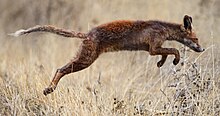
    Note the sharpish nose and long running legs. Might it be a fox?
    Look at the skinny tail, either hairless or covered by very short hair. Couldn't be a fox.
    Given the frequency with which we see foxes passing through the property during daylight and the number of chickens and even a full grown goose taken in the night, we know there is no scarcity of foxes in the neighbourhood, but the foxes we have seen all have luxuriantly bushy tails. This looks like no fox I have ever seen. Except for its long legs, it is also not much larger than a prowling cat which conveniently posed in the same spot (the stake the camera was on was moved slightly further back before the cat sequence was taken).


    Not a cat I have seen before during daylight.
    Note the position of the cat relative to the vine twisting around the post. Although it stands higher off the ground, the body size of the unknown creature is only slight larger than the cat's.
    I have had one or two cameras out now for three weeks looking for unknowns. I lost a week on each of the two cameras. One because I partially ejected the memory card in the process of turning the camera on (one week of camera time wasted!), and the other when I forgot to turn the camera on before I tied it to a stake (another week of camera time wasted!).

    However, I have several more pictures of the mystery animal, both by the bedroom and on the bridge out to the small island in our dam. Coming towards the camera.


    Going away from the camera 10 minutes later:

    Far end of bridge walking away from camera. This guy might have a fox tail.


    Definitely a small fox in the above sequence

    More cats to establish size:

    Another one I have never seen during daylight.
    Yet another cat not seen during the day


    To resolve my questions, I scrolled through numerous fox pictures on Google Images ([IR "red fox"], ["trail camera" "red fox") and got lots of hits, including many with comparable lighting to mine. The notable thing about all of these is the luxuriantly bushy tail - which definitely does not fit my unknown culprit. Wikipedia "red fox" finally solved the conundrum, with a daylight picture. Following are a couple of shots from that page of what foxes should look like:


    The last shot removed any doubt that all of the fox-like creatures photographed by the trail cameras were in fact foxes:


    This guy is suffering from mange! According to Wikipedia "The mite Sarcoptes scabiei is the most important cause of mange in red foxes. It causes extensive hair loss, starting from the base of the tail and hindfeet, then the rump before moving on to the rest of the body. In the final stages of the condition, foxes can lose most of their fur, 50% of their body weight and may gnaw at infected extremities. In the epizootic phase of the disease, it usually takes foxes four months to die after infection."

    My wife hates foxes (we have given up trying to keep chickens on the property), so says Hooray! that at least one fox is suffering.

    More to the point is that the trail cameras have shown beyond a doubt that our 5 acre property is overrun with nocturnal predators that don't belong in Australia - at least three different cats and two different foxes, not counting the occasional sightings during daylight hours. Hopefully they are at least keeping the growing rabbit population under some kind of control.

    Wednesday, 30 October 2013

    RMIT student strategies to make Riddells Creek Landcare stronger

    We're some months on from our project with RMIT, where students doing a strategic management unit used RCL as a case study. They invented strategies for us. We sat and listened to some of their presentations, then read some of the better reports.


    What did we learn? There were three big messages—

    • support our members,
    • invite in more members,
    • form alliances for protection of Barrm Birrm.


     Support our members

    1. Give your members opportunities to do the things they want to do. Keep the focus on protection of native flora and fauna, and education.

    1. Support members in forming into teams around specific projects that they manage themselves.

    2. Make the most of the skills and innovations within RCL, in particular its knowledge of and tools for recording flora and fauna.  Do a skills audit to understand what members can bring to RCL.

    1. Keep track of how happy members are in their projects, because enthusiastic people will spread the word about RCL, and bring in new ideas.

    Invite in more members

    1. Reach out to residents of Riddells who aren’t yet members, and invite them into your activities.

    1. Emphasise the values and beliefs behind what you do – that we have a responsibility to look after our environment, and that learning about the flora and fauna of Riddells is enjoyable and part of being a true resident of this place.

    1. Learn from what we do, feeding back from each project to all members and to the community – think of ourselves as a learning organisation.

    Form alliances for protection of Barrm Birrm

    1. Find corporate partners willing to fund you (or resource you with their expertise eg RMIT) for several years to make BB part of a wider wildlife corridor. Don’t wait for government funding to start this process.

    1. Build alliances with other groups working on large scale landscape protection, like Deep Creek Landcare & Australian Wildlife Society.
    This gives us plenty to work on as we head into the new year (after our AGM). Thanks to all at RMIT, and especially Jason Downs, who believed in the value of giving students real-world experience and supported the students right through. Thanks also to Russell Best and Ross Colliver for presenting Riddells Creek to the students, to Bill Hall for making the connection with RMIT School of Management, and to Gill Best for urging us on and coming to the final presentation of strategies.

    Friday, 18 October 2013

    A 4mm long peacock may be lurking in your backyard

    It is not a bird and it is not a flea

    Male peacock spider (Maratas pavonis), the species known from Victoria / Jurgen Otto photograph 

    Following on from an episode in tonight's ABC Quantum program (17/10/2013) on Jurgen Otto's studies of the marvelous courtship displays of the tiny little peacock jumping spiders of the genus Marata, I had to learn more about them. The name of the Victorian species, pavonis, refers to Pavo - the peacock (bird). The video below is one of a series of 9 showing the behaviors of several different species that Otto has placed on YouTube, so you will see why my sudden interest.


    My first question was, are these fascinating creatures likely to be found in Riddells Creek? So, I checked Natureshare and found only two observations of Maratus pavonis: One by Wendy M from Murray Street, Coburg, and the other by Jody Jackson from near Malcolm Creek in Cragiburn:

    http://natureshare.org.au/observation/3309/
    http://natureshare.org.au/observation/7904/

    Exploring further, I found that peacock spiders are only known from Australia and range in size from 3.5 mm to 7 mm. Mosquito sized males have a multicolored wing-like flaps that they normally hold wrapped around their abdomens.

    Darlington's peacock spider from the Stirling Ranges, WA on someone's finger (Jurgen Otto). His wing flaps are wrapped around his abdomen

    Spider with his cape extended and gesturing with his third legs..


    For more than 100 years, it was was popularly believed that these flaps were used to help the spider fly or glide. Waldock (1993, 2007) discovered that the cape was actually used like the male peacock's tail as a display to females.

    The World Spider Catalog lists 35 species. Otto and Hill (2011) provide fabulous diagnostic photographs of 11 species, including 3 that have not yet been formally described. Otto and Hill also note that Julianne M. Waldock of the Western Australian Museum, who is reviewing and revising the genus, has said that there are probably around 15 more species from Western Australia that still have not been described.

    Given that these mosquito sized guys can even be found in urban backyards in Coburg and Cragieburn, the conclusion I draw from this is that peacock jumping spiders can probably be found in Riddells Creek if you keep your eyes open for little jumping spiders. There may well even be more than one species here - especially in areas of remnant vegetation like Barrm birrm. If you find one that doesn't look like the Natureshare pictures, it is probably an undescribed species.

    Keep a lookout for the little guys - they may well surprise you, and you might even get to name a new species!


    Thursday, 17 October 2013

    Australia's Most Annoying Pest

    Not rabbits, not cane toads, not foxes. What gets up the noses of more Australians than any other pest is the Indian Myna bird. Introduced to Melbourne in the 1860s to combat insects in market gardens, they are agressive, noisy, smart and out-compete native birds.

    Researcher Kate Grarock found the introduction of mynas had led to significant falls in the abundance of 11 bird species in an ruban area. Crimson rosella numbers had fallen from 5.9 per square kilometre to 2.4. Sulphur crested cockatoo numbers had fallen by 2 per square kilometre and kookaburras by about 0.4. (See The Age)

     And they're spreading here in Riddells Creek.

    Riddells resident Stephanie Schabe has had enough. What was one pair has now grown to a small flock of six, and she taking action. Stephanie phoned Landcare this week asking if we were doing anything about Indian Mynas. No we aren't, but we'll back Stephanie by letting our members know about what she's doing.

    To catch Indian Mynas, get a specially constructed cage (plans available, Mens Shed may build, or buy them for $50), then put food in the cage with easy access in and out, so the Mynas get used to coming and going. Then set the cage so they can get in, but not out. Last step - kill the birds, and drop them in your waste bin. It's the killing that's hardest for many people, and a big barrier to taking action. Bill Hall has pointed me to a workshop program that Wollongong City Council offers its ratepayers on how to dispose of caught mynas, and asks if Macedon Ranges offers similar. Not that we know of, but no harm in asking. 

    If you want to get rid of Mynas around your residence, and claim back space for native birds, contact Stephanie Schade on 0419366117, or sschade@netspace.net.au.